Home Charging Hardware
32A vs 40A vs 48A Home EV Charger: Which One Does Your Car Actually Use?
By Yaar· Updated
"Buy the biggest charger you can" is common advice, but it is often wrong. Level 2 charging speed is set by the weakest link in a chain: your electrical panel and circuit, the wall charger, and the car's own onboard charger. If the car can only accept 7.2 kW, a 48 A wall unit charges it no faster than a 32 A unit — and may cost hundreds of dollars more to install.
This guide shows how to match the charger to the car you actually drive, with real 2026 charging times, circuit requirements and a simple decision rule.
How Level 2 charging power works
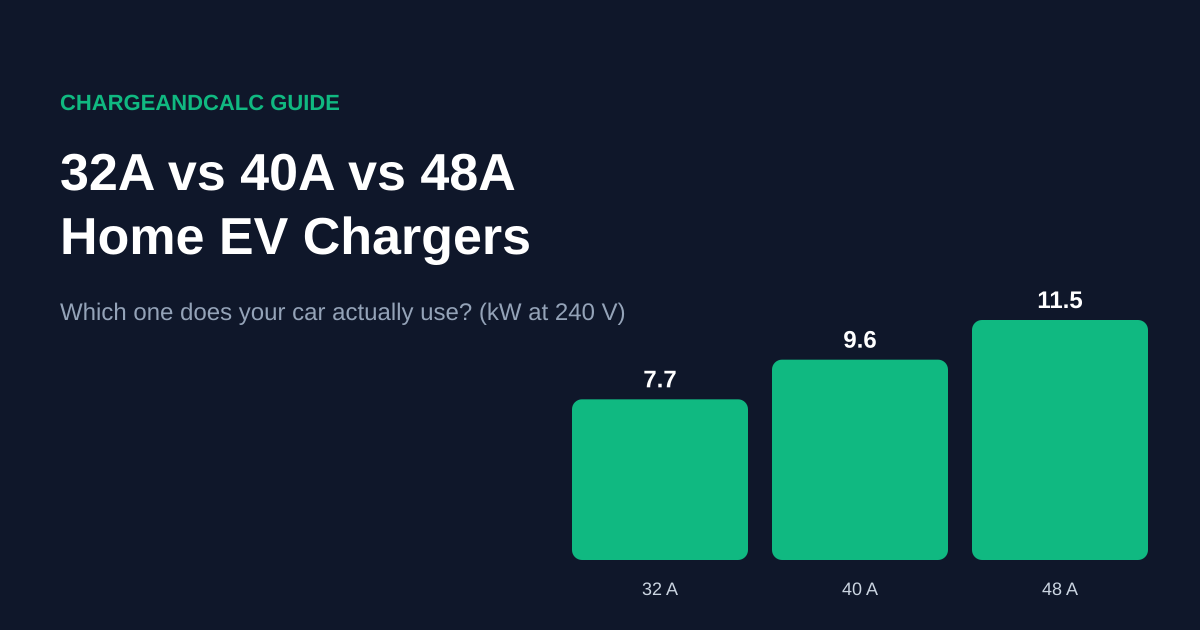
Power is volts multiplied by amps. At the 240 V supply found in most North American homes:
| Charger current | Power at 240 V | Power at 208 V (apartments) | Circuit / breaker | Connection |
|---|---|---|---|---|
| 32 A | 7.7 kW | 6.7 kW | 40 A | Plug-in (NEMA 14-50 or 6-50) or hardwired |
| 40 A | 9.6 kW | 8.3 kW | 50 A | Plug-in (NEMA 14-50) or hardwired |
| 48 A | 11.5 kW | 10.0 kW | 60 A | Hardwired only |
The circuit is always 125% of the charger's current because the National Electrical Code treats EV charging as a continuous load — something that runs for three hours or more. That is why a 48 A charger needs a 60 A breaker. Use the EV charger circuit size calculator to get the matching wire gauge.
The part most buyers miss: your car's onboard charger
The wall unit does not convert electricity for the battery. The car does, using its onboard charger, and every model has a maximum AC input. The car always draws the lower of what the charger offers and what it can accept.
| Vehicle (examples) | Onboard AC charger | Current it can actually use at 240 V |
|---|---|---|
| Nissan Leaf (2026, 75 kWh) | 7.2 kW | ~30 A |
| Hyundai Ioniq 5, Ioniq 6, Kia EV6, EV9 | 10.9 kW | ~45 A |
| Ford Mustang Mach-E, VW ID.4, BMW i4, Polestar 2 | 11 kW | ~46 A |
| Tesla Model 3 / Model Y, Chevrolet Equinox EV, Blazer EV, Honda Prologue, Rivian R1S / R1T | 11.5 kW | 48 A |
| Ford F-150 Lightning Extended Range, Cadillac Lyriq, Lucid Air | 19.2 kW | 80 A (requires an 80 A charger on a 100 A circuit) |
Onboard charger ratings vary by model year and trim, so confirm yours in the owner's manual or on our cost-to-charge pages, which list the onboard charger for each car.
Real charging times: 20% to 80%
Here is how long a typical overnight top-up (20→80%) takes, including about 11% charging losses:
| Vehicle | Energy added | 32 A | 40 A | 48 A |
|---|---|---|---|---|
| Nissan Leaf (7.2 kW limit) | 45 kWh | 7.0 h | 7.0 h | 7.0 h |
| Tesla Model Y Long Range | 45 kWh | 6.6 h | 5.3 h | 4.4 h |
| Ford F-150 Lightning Extended Range | 78.6 kWh | 11.5 h | 9.2 h | 7.7 h |
Two things stand out. First, the Leaf gains nothing from anything above 32 A — its onboard charger is the bottleneck. Second, even for a Model Y, the difference between 32 A and 48 A is about two hours on a charge that happens while you sleep.
How much range per hour?
Range added per hour is the charging power after losses divided by your car's consumption:
| Charger | Efficient EV (~230 Wh/mi) | Mid-size SUV (~270 Wh/mi) | Truck / large SUV (~410 Wh/mi) |
|---|---|---|---|
| 32 A (7.7 kW) | ~30 mi/h | ~25 mi/h | ~17 mi/h |
| 40 A (9.6 kW) | ~37 mi/h | ~32 mi/h | ~21 mi/h |
| 48 A (11.5 kW) | ~45 mi/h | ~38 mi/h | ~25 mi/h |
The average American drives a little over 30 miles a day. Even a 32 A charger replaces a day's driving in about an hour for most cars, and a typical 8-hour overnight window adds well over 200 miles.
Installation cost: where the real difference is
The chargers themselves often cost about the same at 32, 40 and 48 A — many units are adjustable, and you set the current to match your circuit during installation. The difference is in the circuit:
- 32 A and 40 A can use a plug-in charger on a NEMA 14-50 outlet, which is easy to replace or take with you when you move.
- 48 A must be hardwired on a 60 A circuit with heavier wire (6 AWG copper THHN in conduit, or 4 AWG copper NM-B cable).
- Longer runs from the panel to the garage make heavier wire noticeably more expensive.
- A 60 A circuit is more likely to exceed your panel's spare capacity, which can mean a load-management device or, in the worst case, a costly service upgrade.
If your panel is tight, a 32 A or 40 A circuit — or a charger with built-in load management — is often the difference between a routine install and a major electrical project. Our circuit size calculator includes a quick panel headroom check.
Apartments, condos and 208 V supplies
Many apartment and condo buildings supply 208 V instead of 240 V, because they are fed from a three-phase service. The same charger delivers about 13% less power at 208 V: a 48 A unit gives roughly 10 kW instead of 11.5 kW, and a 32 A unit about 6.7 kW. For most drivers that still adds 25–40 miles of range per hour. Shared garages also often use load management, where several chargers split one circuit's capacity, so your car may charge at a lower current during busy evenings. In practice, an overnight session still recovers a normal day's driving with plenty to spare.
Which one should you buy?
Choose 32 A if:
- Your car's onboard charger is 7.2 kW or less.
- You drive under about 60 miles a day and park at home overnight.
- Your panel has limited spare capacity or you're on a 208 V apartment supply.
Choose 40 A if:
- Your car accepts 10.9–11.5 kW and you want a good balance of speed and simplicity.
- You prefer a plug-in charger on a NEMA 14-50 outlet.
- This is the best value for most single-EV households.
Choose 48 A if:
- Your car accepts 11.5 kW or more and you have a reason to need speed: two EVs sharing one charger, a long daily commute, a big truck battery, or a short off-peak window (for example a 4-hour super-off-peak period).
- Your panel can support a 60 A circuit without an upgrade.
Consider 80 A only if you drive an F-150 Lightning Extended Range, Lyriq or another car with a 19.2 kW onboard charger, your panel has room for a 100 A circuit, and you regularly need a big top-up in a short window.
Future-proofing without overspending
If you expect to buy a different EV later, a sensible compromise is to install wire and conduit rated for 60 A now and set an adjustable charger to whatever your current circuit and car need. Upgrading the breaker and charger setting later is cheap; pulling new wire is not. Ask your electrician to quote both options.
The bottom line
Match the charger to the lower of your car's onboard charger and your panel's capacity. For most drivers, 32 A or 40 A delivers everything they need overnight, and 48 A only pays off for high-mileage drivers, two-EV homes and big-battery trucks.
Check exactly how long your car takes on each setting with the EV charging time calculator, and price your overnight charging with the charging cost calculator.