EV Costs & Savings
Home Charging vs. Supercharger Cost Per Mile (2026 Data Breakdown)
By Yaar· Updated
The single biggest factor in what an EV costs to run is not the car — it is where you charge it. The same Tesla Model Y can cost under 3 cents a mile on an overnight home plan or more than 14 cents a mile when you rely on fast chargers. That gap is wider than the difference between many EVs and gas cars.
This breakdown uses 2026 average prices to compare home charging, off-peak home charging and DC fast charging (including Tesla Superchargers) against gasoline, per mile and per year.
The method
To compare fairly, everything is converted to cost per 100 miles:
- Car: Tesla Model Y Long Range AWD — 75 kWh usable battery and 327 miles EPA range, or about 229 Wh per mile at the battery.
- Home charging: about 11% charging loss on Level 2, so each mile takes about 257 Wh from the wall.
- DC fast charging: stations bill the energy delivered to the car; we add about 5% for on-car losses (battery heating and cooling).
- Gas comparison: a 30 MPG gas car at $3.10 per gallon.
- Annual totals: 12,000 miles per year.
All formulas are documented on our methodology page, and you can rerun any of these numbers with your own rates in the charging cost calculator.
Cost per 100 miles: home vs fast charging vs gas
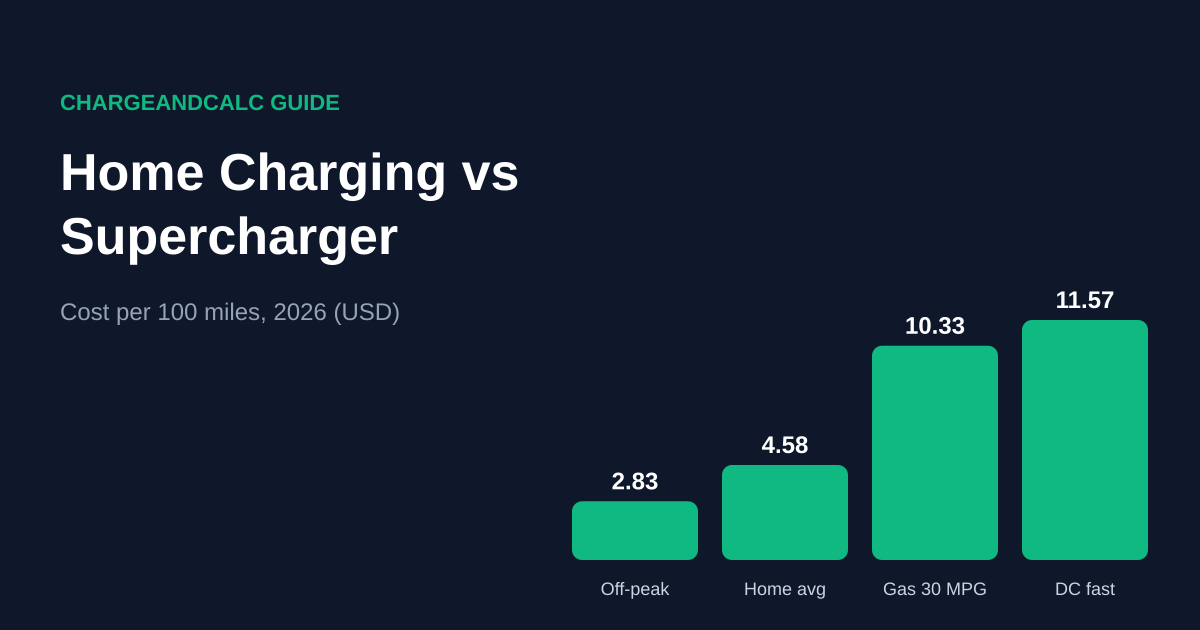
| How you fuel | Price | Cost per 100 miles | Cost per year (12,000 mi) |
|---|---|---|---|
| Home, off-peak EV plan | $0.11/kWh | $2.83 | $340 |
| Home, US average rate | $0.178/kWh | $4.58 | $550 |
| Home, expensive state (e.g. California) | $0.33/kWh | $8.49 | $1,019 |
| DC fast charging, low | $0.30/kWh | $7.23 | $868 |
| DC fast charging, typical | $0.48/kWh | $11.57 | $1,388 |
| DC fast charging, high | $0.60/kWh | $14.46 | $1,736 |
| Gas car, 30 MPG | $3.10/gal | $10.33 | $1,240 |
Three conclusions jump out:
- Home charging at the average US rate costs less than half as much as gas for the same distance.
- Off-peak home charging costs about a quarter as much as gas. An EV plan is worth looking up before you buy a charger.
- Fast charging can cost more than gas. At typical 2026 DC prices around $0.48/kWh, a Model Y driver who only fast charges pays slightly more per mile than a 30 MPG gas car driver.
Why fast charging costs so much more
Public DC fast chargers are expensive to build and operate. Operators pay for high-power grid connections, demand charges from utilities (fees based on peak power draw, not just energy), hardware that can cost six figures per stall, maintenance and payment processing. Those costs end up in the price per kWh.
Tesla Superchargers are often at the lower end of public fast-charging prices, but pricing varies by location and often by time of day, and non-Tesla drivers using Superchargers through the NACS connector typically pay more than Tesla owners or members. Other networks commonly charge somewhere between about $0.40 and $0.65 per kWh for non-members in 2026.
What about other EVs?
Efficiency changes the picture. A less efficient vehicle pays more per mile everywhere, and feels fast-charging prices more:
| Vehicle | Battery-side Wh/mi | Home ($0.178/kWh) per 100 mi | DC ($0.48/kWh) per 100 mi |
|---|---|---|---|
| Hyundai Ioniq 6 Long Range RWD | 226 | $4.53 | $11.43 |
| Tesla Model Y Long Range AWD | 229 | $4.58 | $11.57 |
| Chevrolet Equinox EV FWD | 266 | $5.33 | $13.46 |
| Ford F-150 Lightning Extended Range | 409 | $8.19 | $20.68 |
For a large electric truck, fast charging at typical prices costs about $20 per 100 miles, well above a 30 MPG gas car. Home charging is what makes big EVs economical to run. Compare any model on our cost to charge by car pages.
The real-world mix: most drivers blend both
Few EV owners use only one method. National studies of charging behaviour consistently find that drivers with home charging do the large majority of their charging at home, with fast charging mostly used on road trips. Here is how the annual cost of the Model Y changes as the fast-charging share grows (home at $0.178/kWh, DC at $0.48/kWh):
| Share of charging on DC fast chargers | Cost per 100 miles | Cost per year (12,000 mi) |
|---|---|---|
| 0% (home only) | $4.58 | $550 |
| 10% | $5.28 | $634 |
| 25% | $6.33 | $759 |
| 50% | $8.08 | $969 |
| 100% (fast charging only) | $11.57 | $1,388 |
Even at a 25% fast-charging share, this Model Y still costs about $480 a year less to fuel than the 30 MPG gas car. Try your own mix in the EV vs gas savings calculator using the public charging slider.
A worked example: one month of driving
Numbers per 100 miles can feel abstract, so here is a single month for a Model Y driver covering 1,000 miles, split between commuting and one weekend road trip:
- 850 miles of commuting, charged overnight at home on a $0.11/kWh off-peak plan: about 218 kWh from the wall, costing roughly $24.
- 150 miles of road trip, charged at a DC fast charger at $0.48/kWh: about 36 kWh billed, costing roughly $17.
- Total: about $41 for 1,000 miles, or 4.1 cents a mile.
The same 1,000 miles in a 30 MPG gas car at $3.10 per gallon costs about $103. Even though the road-trip miles cost more per mile than gasoline, they are a small share of the month, and the cheap overnight miles dominate the total. This is why a realistic charging mix matters far more than the headline price at any single charger.
Drivers without home charging
If you live in an apartment or park on the street, your cost per mile depends on what's nearby:
- Workplace or destination Level 2 charging is often free or priced close to home rates.
- Curbside and Level 2 public chargers usually cost less per kWh than DC fast chargers.
- Fast-charging memberships lower the per-kWh price in exchange for a monthly fee. They pay off once your monthly fast charging passes the break-even point (fee ÷ discount per kWh).
- Utility multifamily programs in some states help landlords install shared chargers.
If fast charging will be your main option, compare the EV's cost per mile against an efficient hybrid before buying. The road trip cost calculator compares per-kWh, per-minute and member pricing for a given trip.
How to get the lowest cost per mile
- Charge at home on a time-of-use or EV plan. Moving from $0.178 to $0.11/kWh cuts the Model Y's fuel cost by about $210 a year.
- Fast charge only when you need to, and stop around 80% — above that, charging slows sharply and per-minute pricing gets expensive.
- Use off-peak station pricing where networks offer it.
- Pick an efficient EV if you expect to rely on public charging; the per-mile gap between efficient sedans and big trucks is huge at DC prices.
- Use Level 2, not Level 1, at home to reduce charging losses.
The bottom line
In 2026, home charging at an average US rate costs about 4.6 cents a mile in an efficient EV, and under 3 cents on an off-peak plan. Fast charging typically costs 10–15 cents a mile, which is similar to or more than gas. The economic case for an EV rests on charging at home most of the time — and the cheaper your home rate, the stronger it gets.
Plug your actual utility rate into the charging cost calculator or see typical prices on our electricity rates by state pages.