EV Charging
Why You Pay for More kWh Than Your Battery Receives (EV Charging Losses Explained)
By Yaar· Updated
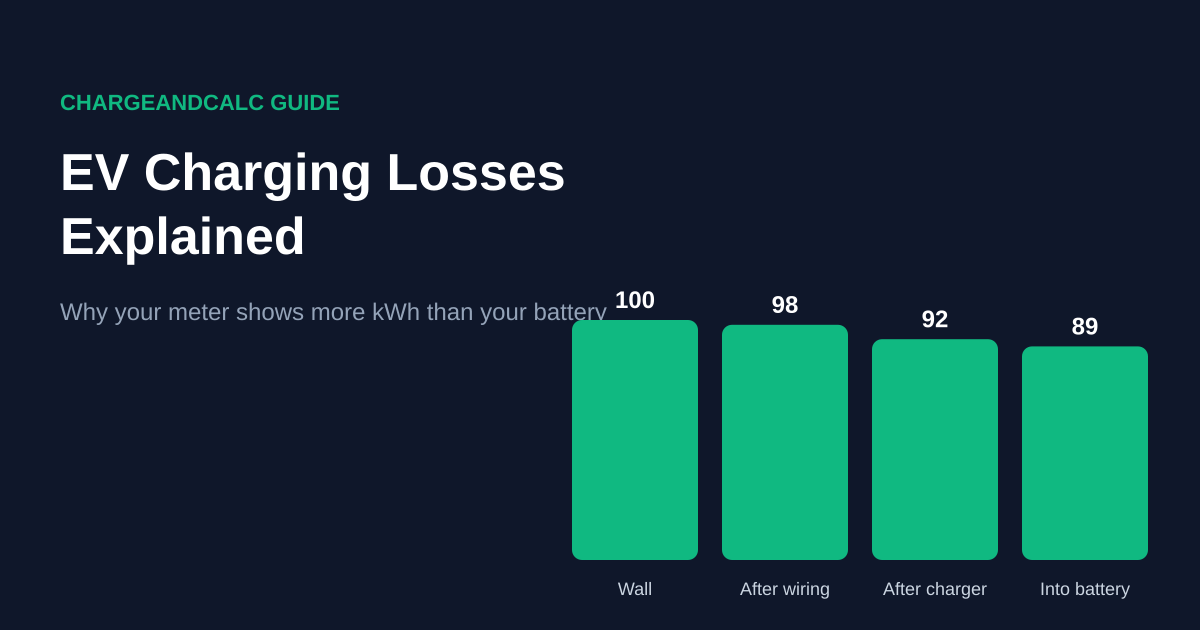
If you have ever compared your EV app with your electricity bill, you may have noticed a gap. The car says it added 45 kWh. The utility's smart meter or your charger's app says you used 50 or more. Nothing is broken. You are seeing charging losses: energy that leaves the wall but never ends up stored in the battery.
Charging losses are small enough to ignore on any single night, but over a year they add up to real money. They also explain why careful cost calculators — including ours — divide by a charging efficiency instead of simply multiplying battery kWh by your rate. This guide explains where the energy goes, how much is typically lost, and what you can do about it.
The short answer
For a typical Level 2 home charger, expect roughly 8–15% of the energy from the wall to be lost before it reaches the battery. On a 120 V Level 1 outlet the loss is usually higher, often 15–20% or more. That is why the EV charging cost calculator uses an 11% default loss: it is a realistic middle value for Level 2 charging in mild weather.
In practical terms, if your battery needs 45 kWh, your meter will usually record about 50–53 kWh.
Where does the energy go?
Charging an EV is not a single step. Electricity passes through several components, and each one turns a little of it into heat.
1. The wall unit and wiring
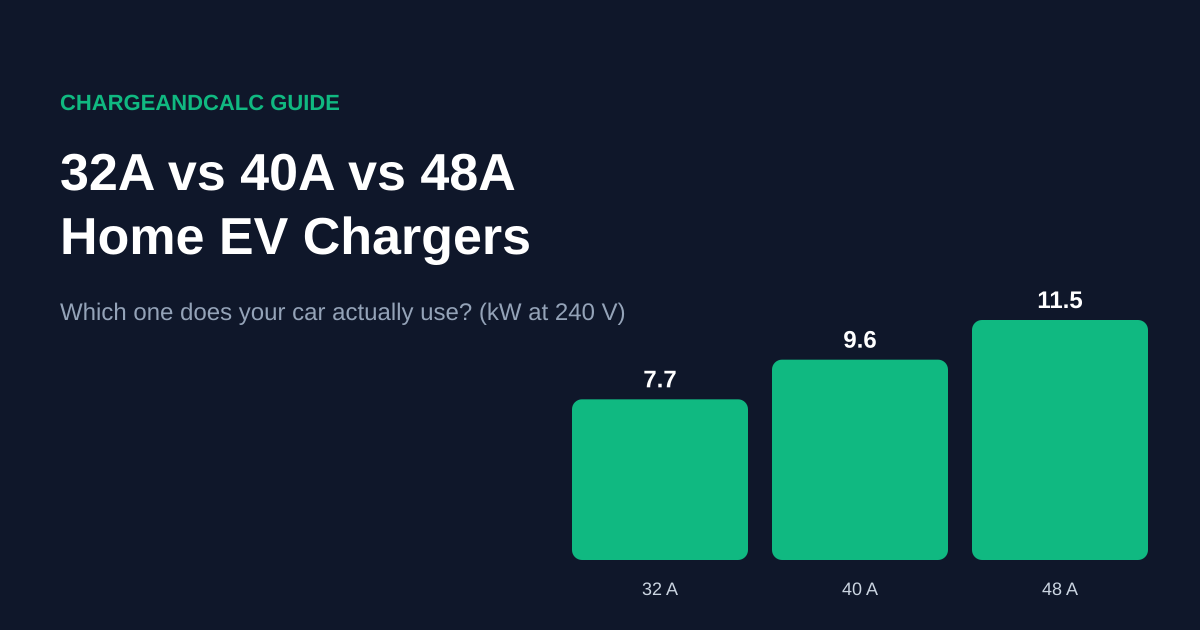
Your charger (technically the EVSE) mainly acts as a smart switch, so it adds very little loss itself. The copper wiring between your panel and the car does have resistance, though, and it heats up slightly under a 32–48 A load for hours at a time. A long run on undersized wire wastes more, which is one reason correct wire gauge matters (see our charger circuit size calculator).
2. The onboard charger (AC to DC conversion)
Your home supplies alternating current (AC), but batteries store direct current (DC). The onboard charger inside the car converts one to the other. Modern onboard chargers are efficient, but not perfect: the conversion typically loses a few percent, and efficiency drops when the charger runs well below its rated power.
3. The battery itself
Pushing current into lithium-ion cells generates heat because of the battery's internal resistance. The faster you charge, the more current flows and the more heat is produced, although at home charging speeds this loss is modest.
4. Keeping the car awake
While it charges, the car's computers, battery management system, coolant pumps and 12 V system are all running. This fixed overhead — often a few hundred watts — is the main reason slow charging is less efficient. It costs the same per hour whether you are adding 1.4 kW or 11.5 kW.
5. Heating or cooling the battery
In cold weather, many EVs warm the battery before or during charging so it can accept energy safely. In very hot weather they may run the cooling system. That conditioning energy comes from the wall but never ends up as stored range.
How losses compare by charging method
| Charging method | Typical power | Typical efficiency (wall → battery) | Why |
|---|---|---|---|
| Level 1 (120 V outlet) | 1.2–1.9 kW | 80–85% | Fixed overhead runs for 20–40+ hours |
| Level 2 (240 V, 32–48 A) | 7–11.5 kW | 85–92% | Overhead spread over fewer hours; efficient onboard charger |
| DC fast charging | 50–350 kW | 90–95% (as billed) | Conversion happens in the station, which bills delivered energy; on-car losses are mostly battery heat and cooling |
These are typical ranges, not guarantees. Cold weather, very low amperage settings and cars that stay awake can push losses higher.
What the losses cost you
Here is the same 45 kWh battery top-up (60% of a 75 kWh pack) at the 2026 US average residential rate of about $0.178/kWh, at different charging efficiencies:
| Charging efficiency | Energy from the wall | Energy lost | Cost |
|---|---|---|---|
| 92% | 48.9 kWh | 3.9 kWh | $8.71 |
| 89% (our default) | 50.6 kWh | 5.6 kWh | $9.00 |
| 85% | 52.9 kWh | 7.9 kWh | $9.42 |
| 80% (typical Level 1) | 56.3 kWh | 11.3 kWh | $10.01 |
Scaled up to a year, the difference becomes visible. A Tesla Model Y Long Range uses about 229 Wh per mile at the battery. Over 12,000 miles that is about 2,750 kWh stored in the battery. At 89% efficiency the meter records roughly 3,088 kWh ($550); at 80% it records about 3,435 kWh ($611). Charging exclusively on Level 1 costs this driver around $60 more per year than Level 2 — and more in states with expensive electricity.
Why your car's numbers and your bill never match
Your car reports energy added to the battery (and sometimes its trip computer reports energy used for driving, which is lower still). Your utility meter, or a networked charger's app, reports energy taken from the grid. The difference is the loss.
This also matters when reading official efficiency figures:
- EPA kWh per 100 miles and MPGe are measured from the wall, so they include charging losses.
- Usable battery capacity ÷ EPA range gives battery-side consumption, which excludes them.
Our calculators use the second approach and then add the loss back explicitly, so you can see — and change — the assumption. If you mix the two methods, for example by applying an 11% loss to an EPA wall-based figure, you will double-count the losses and overestimate your costs.
Does DC fast charging have losses?
Yes, but you usually do not pay for most of them. A DC fast charger converts AC to DC inside the station, and in most US states and in the UK, stations now bill by the energy delivered to the car. The station's own conversion losses are the operator's cost (and are built into the price per kWh).
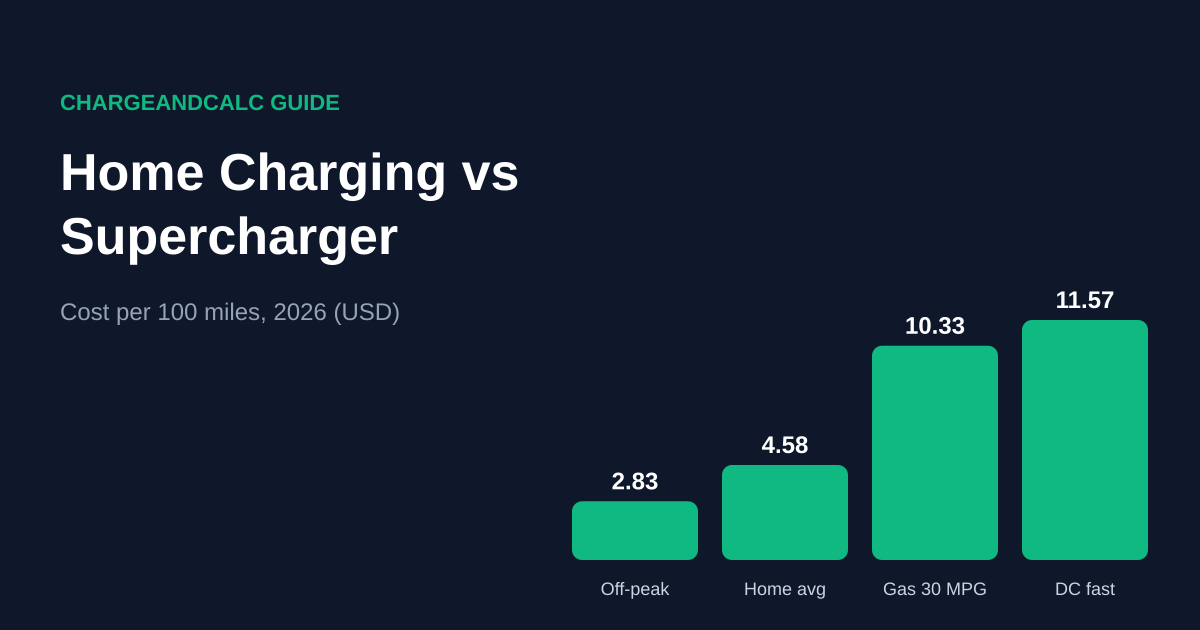
On the car side, you still lose some energy to battery heat and to the cooling system working hard at high power. That is why our calculators use a roughly 5% on-car loss for DC sessions. The bigger cost difference is the price: public DC charging often costs two to four times as much per kWh as charging at home. See home charging vs Supercharger cost per mile for the full comparison.
Seven ways to reduce charging losses
- Use Level 2 if you can. Moving from 120 V to 240 V is the single biggest efficiency gain, because it cuts the hours of fixed overhead dramatically.
- Don't throttle the current too low. Charging at 8–12 A on Level 2 brings back the overhead problem. If you need to limit current for your panel, a moderate setting is still better than a very low one.
- Charge when the battery is warm. In winter, plugging in right after a drive, or scheduling charging to finish just before you leave, means less energy goes into warming the pack.
- Precondition while plugged in. If you heat the cabin before a winter trip, do it while connected. The energy still costs money, but you start with a full battery and a warm pack, which improves driving efficiency too.
- Turn off energy-hungry features while charging. Camera-based security modes and frequent app polling keep the car's computers awake.
- Use correctly sized wiring. Long runs on minimum-gauge wire waste a little energy as heat. An electrician can check voltage drop on long runs.
- Check your utility rate first. Losses cost 8–15% extra; a time-of-use plan can cut your price per kWh by 30–60%. Get the rate right before worrying about the last few percent.
The bottom line
Charging losses are normal and unavoidable, but they are not huge. On a Level 2 charger in mild weather, assume you buy about 12% more energy than your battery stores (an 89% efficiency). On a 120 V outlet or in very cold weather, assume more. Factor this into any cost estimate and you will find your calculations match your electricity bill far more closely.
Try your own numbers in the EV charging cost calculator, where you can switch the loss factor on and off and set your own percentage, or see how long each charging level takes with the charging time calculator.